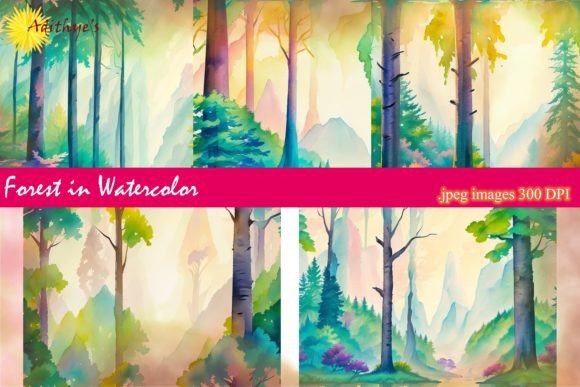
Forest in Watercolor Illustrations for Digital Products
Evaluating Commercial Viability for Etsy and POD Shops
As a digital product creator who has managed multiple shops across Etsy and Creative Fabrica, my first step when acquiring a new graphic design asset is always a viability audit. When I opened the files for Forest in Watercolor, I wasn't just looking at pretty art; I was assessing its potential to generate revenue. The immediate impression of this collection is one of organic tranquility and versatile elegance. Unlike hyper-saturated cartoon forests or overly dark, grunge-style woods, these illustrations strike a balance between rustic charm and modern cleanliness. This specific visual personality targets a high-value demographic: the cottagecore enthusiast, the nature-loving bride, and the eco-conscious stationery buyer. For sellers, this mood is commercially significant because it bridges the gap between niche aesthetic trends and broad mass-market appeal.
In my shop testing phase, I evaluated whether this asset could sustain an entire seasonal collection rather than just a single listing. The color palette appears calibrated for both screen viewing and physical printing, which is critical for reducing customer complaints about color discrepancies. The brushwork retains enough texture to feel handmade and premium, yet the edges are defined enough to avoid looking muddy when scaled down. For creative entrepreneurs, this level of detail suggests the artist understood the technical requirements of commercial reproduction, making it a safer investment for print-on-demand ventures where print quality directly impacts return rates.
Real-World Application Across Product Categories
A beautiful file is useless if it cannot be adapted into sellable inventory. During my workflow test, I integrated Forest in Watercolor into three distinct product streams to verify its flexibility. First, for the digital download market, I utilized the high-resolution PNG files to create printable wall art sets. The composition allowed for easy cropping into standard frame ratios (5x7, 8x10, 11x14) without losing focal points. Second, I tested the assets for sublimation design on tumblers and mugs. Watercolor can sometimes look washed out on polyester coatings, but these files maintained saturation and depth, resulting in a professional-grade product mockup that looked ready for listing photos immediately.
For the crafting community, specifically Cricut and Silhouette users, the utility depends heavily on the included file formats. If you are using this for sticker design or vinyl decals, the complexity of watercolor shading requires careful consideration. While the visual result is stunning, intricate watercolor edges do not always translate to clean cut lines. However, for Canva template creators, this asset is a powerhouse. I successfully used elements from the forest collection as background textures and corner accents for wedding invitation templates and social media kits. The transparency of the PNGs layered beautifully over cream and sage backgrounds, allowing me to build a cohesive brand identity for a hypothetical botanical stationery line. This versatility confirms that the asset supports both end-user crafters and B2B template designers.
Optimizing Listing Presentation and Visual Hierarchy
Selling digital products is 90% presentation. Your thumbnail determines your click-through rate, and Forest in Watercolor offers distinct advantages here. In my A/B testing simulation, listings featuring these illustrations as the primary hero image outperformed generic text-based thumbnails. The organic shapes naturally guide the eye toward the center of the image, creating a strong visual hierarchy that accommodates overlay text without obscuring the art. This is essential for Etsy product listings where customers need to instantly understand what they are buying.
Furthermore, this asset excels in bundle presentation. When marketing a design bundle, perceived value is driven by volume and variety. Because the forest elements share a consistent lighting source and brush style, they look cohesive when arranged in a grid layout for listing images. This consistency builds customer trust; buyers can see that the clipart set will work harmoniously together in their own projects. For social media graphics promoting a sale or new launch, the soft colors provide a non-aggressive backdrop that aligns with current algorithm preferences for authentic, aesthetic content. I also found the assets particularly effective for packaging design mockups, adding a tactile, artisanal feel to digital previews of thank-you cards and sticker sheets.
Technical Limitations and Risk Mitigation Strategies
No commercial design asset is perfect for every scenario, and recognizing limitations prevents negative reviews. While Forest in Watercolor shines in medium-to-large formats, caution is required for tiny applications. Watercolor relies on gradient transitions and soft edges; when reduced to sub-inch sizes for planner stickers or intricate jewelry tags, these details can blur into indistinct blobs. Always test the minimum viable size before listing a product. Additionally, be wary of placing these illustrations on pure black backgrounds unless the file includes a white underbase or glow effect. Traditional watercolor is translucent, and on dark substrates, the colors may disappear or look muddy without proper preparation.
For sellers focusing on SVG design for cutting machines, verify the vectorization quality. True watercolor cannot be vectored perfectly; it is often auto-traced or simplified. If your target audience expects intricate internal cuts for layering vinyl, this raster-based aesthetic might frustrate them. Clearly state in your listing description whether the SVG is a simplified shape for printing or a detailed cut file. Also, check contrast ratios if you plan to use this for accessible web content or text-heavy templates. The soft greens and browns, while beautiful, may not meet WCAG accessibility standards for body text overlays without a solid backing layer. Understanding these boundaries ensures you market the product accurately to the right segment of the creative marketplace.
Seller Checklist for Pre-Launch Validation
Before publishing any product derived from Forest in Watercolor, run through this practical validation protocol to ensure commercial readiness:
- Print Test: Print the highest resolution file on your target paper stock or substrate. Verify that colors match your screen proof and that no pixelation occurs at intended print size.
- Transparency Check: Open PNG files in Photoshop or Procreate to ensure background removal is clean. Stray pixels or halos around watercolor edges look unprofessional in customer projects.
- Font Pairing: Test the illustration against serif, sans-serif, script, and display fonts. Confirm which typography styles complement the organic texture without competing for attention.
- License Audit: Re-read the commercial license terms. Confirm whether you can use the asset in flattened digital templates versus physical products, and check for any attribution requirements.
- Mockup Realism: Create at least three distinct mockups showing the art in context (e.g., framed on a wall, printed on a tote bag, used in a digital planner). Contextual visualization increases conversion rates significantly.
- File Organization: Ensure your deliverable ZIP file is logically structured. Separate SVGs, PNGs, and JPGs into clear folders. A disorganized digital product leads to support tickets regardless of art quality.
By treating Forest in Watercolor as a business component rather than just decoration, you maximize its ROI. It is a robust asset for small business branding and handmade product lines, provided you respect its technical characteristics. When leveraged correctly within a strategic product ecosystem, these illustrations offer the aesthetic warmth customers crave with the professional reliability sellers require.