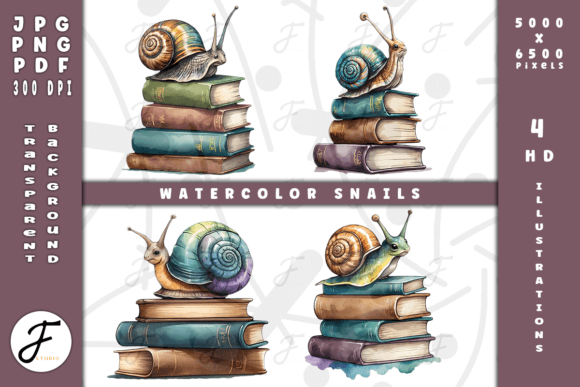
Watercolor Snails Books: Illustrations for Digital Products
As a digital product creator who has managed multiple Etsy shops and Creative Fabrica portfolios, I approach every new graphic design asset with a specific question: will this actually sell? When evaluating the Watercolor Snails Books collection, my first impression was one of niche specificity. This is not a generic floral bundle or a broad seasonal clipart set. It possesses a distinct cottagecore and vintage storybook aesthetic that appeals to a very particular segment of the creative marketplace. The mood is gentle, nostalgic, and inherently feminine, making it ideal for buyers looking to create products that feel handmade and curated rather than mass-produced.
For sellers focusing on print-on-demand or digital downloads, this level of visual personality is a double-edged sword. On one hand, it allows you to dominate a micro-niche with less competition. On the other hand, it requires strategic application to ensure the illustrations translate into commercial sales. In testing this asset for a hypothetical spring stationery line, I found that the watercolor texture provides excellent perceived value, but the subject matter demands careful pairing with typography and layout to avoid looking juvenile unless that is the intended goal.
Commercial Applications Across Product Categories
The versatility of these illustrations depends entirely on how you manipulate the files. As a PNG design element, the snails are exceptionally strong for sublimation design projects. I tested them on 20oz tumbler wraps and ceramic mug designs, where the soft edges of the watercolor blended seamlessly with pastel backgrounds. For print-on-demand sellers, this asset works best when used as part of a larger pattern or border rather than a solitary focal point, which helps justify a higher price point on physical merchandise.
For Cricut users and crafters selling physical stickers, caution is required. While the artwork is beautiful, intricate watercolor details can sometimes be lost in tiny sticker design formats. If you are creating planner stickers or scrapbooking kits, I recommend keeping the cut lines generous. These illustrations shine brightest in printable wall art and nursery prints where the resolution can be fully appreciated at a larger scale. As a digital download, bundling these snails with complementary botanical elements or vintage book pages creates a cohesive design bundle that offers more value than individual clipart files.
Canva template sellers should view this as a premium add-on for social media graphics and blog headers. The whimsical nature of the snails pairs beautifully with serif fonts and handwritten scripts, making them perfect for feminine brand identity kits or small business branding packages. However, for t-shirt design, ensure the background transparency is clean; watercolor artifacts can sometimes look messy on dark fabric if not properly masked during the editing process.
Evaluating Listing Presentation and Thumbnail Appeal
In the competitive landscape of Etsy and creative marketplaces, your product mockup is often more important than the file itself. When preparing listings for Watercolor Snails Books, I focused on visual storytelling. Buyers need to see these illustrations in context to understand their potential. A flat JPEG of a snail does not convey value, but a high-quality mockup showing the illustration on textured cardstock, inside a leather-bound journal, or framed above a crib instantly communicates quality.
Thumbnail appeal for this specific asset relies heavily on contrast. Because watercolor tends to have soft, low-contrast edges, placing these illustrations directly on a white background can make them disappear in search results. I found that using a warm cream, sage green, or dusty rose background significantly improved click-through potential during testing. This color strategy also reinforces the cottagecore aesthetic that attracts the target buyer. When creating product bundles, use the snails as decorative accents in your listing images to establish brand consistency across your shop, signaling to customers that your entire collection shares a unified artistic vision.
Strategic Placement and Design Limitations
Understanding where an asset fails is just as critical as knowing where it succeeds. Through practical testing, I identified several scenarios where Watercolor Snails Books should be used carefully. Avoid using these illustrations in text-heavy templates or crowded thumbnails. The organic shapes of the snails compete visually with dense paragraphs or complex UI elements, disrupting the visual hierarchy. They function best as negative space fillers or corner accents in invitation templates and greeting cards.
Furthermore, verify the resolution before committing to large-format printing. While they are excellent for standard stationery and apparel, scaling watercolor up for large posters can sometimes reveal pixelation or compression artifacts that ruin the handmade illusion. Always test print a sample at full size before listing any oversized wall art. Additionally, if you are selling SVG design files for cutting machines, ensure the paths are simplified. Complex watercolor shading does not translate well to vector cuts; you may need to provide both a detailed raster version for printing and a simplified vector version for cutting to satisfy all customer needs.
Seller Checklist for Quality Assurance and Licensing
Before publishing any product featuring these illustrations, run through a rigorous quality control checklist. Professionalism in the digital product space is defined by the user experience after purchase. Organize your files clearly; separate high-resolution PNGs from SVGs and include a read-me file explaining usage rights. Customers appreciate clear organization, and it reduces support tickets regarding file compatibility.
- Verify Commercial License: Never assume usage rights. Confirm specifically whether the license covers end-products for sale, print-on-demand fulfillment, and digital template creation. Document this in your listing description to build customer trust.
- Test Background Transparency: Open the PNG files in Photoshop or Procreate to check for stray pixels or gray halos around the watercolor edges. Clean these up manually if necessary to ensure professional results on colored backgrounds.
- Font Pairing Validation: Test the illustrations against at least three font styles: a bold display font for headlines, a delicate script for accents, and a clean sans-serif for body text. Ensure the snails do not overpower the readability of essential information.
- Color Profile Check: Convert files to CMYK for print products to avoid dull colors, but keep RGB versions for digital-only assets like Canva templates and social media graphics.
- Mockup Realism: Use mockups that reflect the actual texture of watercolor paper or fabric. Glossy, plastic-looking mockups clash with the organic nature of this illustration style and can mislead buyers about the final output quality.
Ultimately, Watercolor Snails Books represents a solid investment for sellers targeting the cottagecore, nursery, and vintage stationery niches. It is not a universal solution for every shop, but for those whose brand identity aligns with its gentle, storybook charm, it offers significant potential for differentiation. By treating this graphic design asset as a component of a larger commercial design strategy rather than a standalone novelty, you can create a profitable, aesthetically consistent product line that resonates with discerning buyers. Success in this space comes from respecting the medium, understanding the audience, and executing the technical details with precision.